Beyond the Schengen Wall: “Construction of Borders” in Maribor | My Mobility Journal
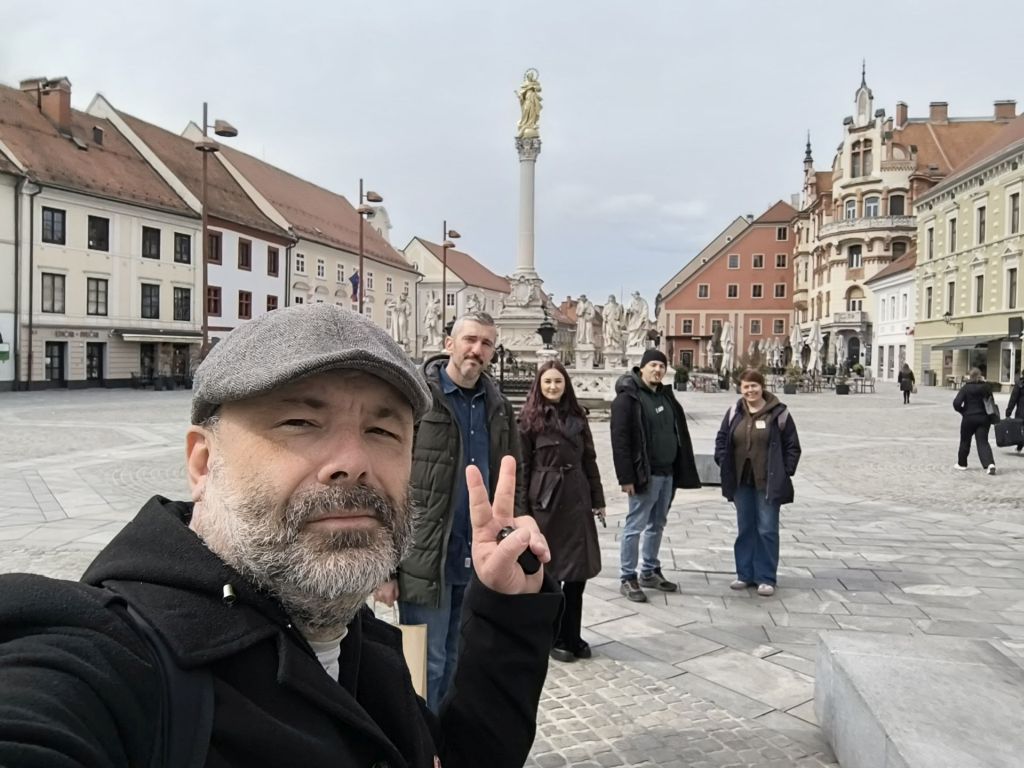
From March 28 to April 4, 2026, as artists from Bosnia and Herzegovina, we stayed in Maribor within the framework of the international project Construction of Borders: Between Signature and Erasure, organized by the Association Hiša! for People and Space. During our stay, the installation and opening of the eponymous exhibition, professional meetings, and a series of visits to important cultural institutions and independent spaces of Maribor were realized.
28.03.2026.
Our journey from Sarajevo began early in the morning from the Arka – Art & Education Center. We traveled by single car, Denis Haračić as a designated driver, and Amer Hadžić and I as working hands, packed selected works for the exhibition and set on the road. In Vogošća we stopped to pick up Eldina Kožljak. It was nice day, clearing after few days of snow and rain. We made one break along the way not expecting that we will be stuck on border for hours. Due to new procedures for entering the Schengen Area, which include photographing and taking biometric data, the journey lasted longer than planned. Precisely this new system of entering the EU from BiH reflects from the very start the importance of this project. The first working meeting was held in the evening hours upon arrival in Maribor in BrewPub with Maja Pegan on behalf of Hiša!. On that occasion, with the local beer in the hand (after all it was after working hours), the activity plan for the following days was adopted and tasks related to the production of the exhibition were specified.


29.03.2026.
Sunday was a day set aside for rest and recovery from the journey. However, the day was not entirely passive; we took the opportunity to transport two additional paintings from Celje to complete the exhibition setup. We also held a meeting with Admir Ganić, an external member of Arka. It was easy going yet logistically crucial prelude to the week that followed.
30.03.2026.
Early on our Arka delegation visited the KIBLA Multimedia Center, one of the most important independent cultural institutions in Slovenia. KIBLA was founded in 1996 as a center focused on multimedia, intermedia art, and the creative use of new technologies. During three decades of work, it has developed a strong international program of exhibitions, education, and European collaborations. Our host for the meeting was Peter Tomaž Dobrila, co-founder of KIBLA, a producer, and one of the key figures of contemporary culture in Maribor. During the visit, we also viewed a solo exhibition by Maribor artist Jože Šubic titled Naredi sliko (Take a Picture). Šubic, born in 1958 in Maribor, belongs to an established generation of Slovenian authors with a long continuity of work in painting, sculpture, printmaking, and drawing, and his works are held in the collections of major museums and galleries in Slovenia. The exhibited cycle of large-scale formats deals with the body, intimacy, and the gaze as visual and social categories, opening questions about how our relationship with erotica, subjectivity, and representation changes over time. Dobrila says of Šubic’s works that they invite the viewer “to enter the image, to experience it, and absorb it through presence.” And for Nina Šardi, the works do not act as a provocation but as a “natural part of the symbolic, mythological, and everyday imaginary,” while the title Take a Picture itself suggests an act of observation, recording, and control that is gradually questioned within the paintings. Numerous references to art history—from The Dream of the Fisherman’s Wife (after Hokusai) to Louise Bourgeois, Francisco Goya, and Marcel Duchamp—give the series a special complexity, through which Šubic establishes a dialogue between the past and the contemporary moment. It was particularly interesting for us to see his interpretation of Hokusai’s Ama and the Octopus motif, which opened a direct connection to my work, as I reinterpreted the same theme back in 2011 in my own artistic practice, confirming how certain motifs from art history continue to live on through different authors, contexts, and generations.
After the visit to KIBLA, as members of the delegation, we also visited Narodni dom Maribor (National House Maribor), one of Slovenia’s most important cultural institutions. This is a historically exceptionally significant institution located in a representative Neo-Renaissance palace built in 1898 as the central home of Slovenian culture in what was then a predominantly German urban environment of the Austro-Hungarian Empire. The building itself represents a powerful symbol of cultural identity, emancipation, and the institutional development of the Slovenian community in Maribor. Today, National House Maribor manages a series of important programs and spaces, including Festival Lent, the largest festival event in Slovenia and one of the most recognizable summer festivals in the region. Each year, the festival gathers a wide spectrum of musical, theatrical, dance, film, and street programs, transforming the entire city into an open cultural stage. I found their educational program, Kulturni dnevnik (Cultural Diary), to be particularly valuable—it is one of the most significant cultural-educational models for school-aged children in Slovenia. The program is aimed at the youngest audience, specifically children aged 6 to 10, and through encounters with theater, music, visual arts, and cultural heritage, it develops an early relationship with art and culture. Such examples show us how serious cultural institutions simultaneously nurture top-tier artistic programs and invest in their future audience for the long term.
On the same day, we visited GT22, one of the most significant examples of contemporary independent cultural infrastructure in Slovenia and the wider region. Located in a former municipal building in the center of Maribor, GT22 has been developed over the last decade as a multifunctional platform that integrates artistic production, education, archiving, and public programs. Operating within its framework are film initiatives, the Mišnica photography platform, the Modrinjak Photography Museum, radio production, printmaking studios, gallery spaces, theater and performance organizations, as well as a series of smaller collectives and socially engaged projects. We were guided through the center by Miha Horvat, a Slovenian actor and one of the platform’s key collaborators and producers, who presented the way GT22 functions as an open system of cooperation between several autonomous but interconnected initiatives. Precisely this model makes GT22 a rare example of a sustainable cultural grassroots ecosystem, where production, community, and daily life organically intertwine.
The afternoon was reserved for us to install the exhibition Construction of Borders: Between Signature and Erasure in the gallery space of the Minorite Church basement, within the Minoriti Cultural Quarter complex.


31.03.2026.
As we had packed Monday, we took day to stroll around Maribor and to get acquainted with the city. Exhibition was 80% set and there were some minor details to adjust. In the evening we attended the opening of the exhibition NAGRAJENKE DLUM 2025 – Intimate Matter: Natalija R. Črnčec, Katja Majer, Slađana Matić Trstenjak. DLUM – the Association of Fine Artists Maribor (Društvo likovnih umetnikov Maribor) represents one of the key professional associations for visual artists in northeastern Slovenia. It was founded with the aim of professionally connecting authors, protecting the status of artists, and ensuring the continuous development of the contemporary art scene in Maribor and the region. Over decades of activity, DLUM has played an important role in the affirmation of numerous authors, organizing exhibitions, professional programs, public discussions, and linking the local scene with national and international trends in contemporary art. Their gallery in the center of Maribor is one of the few places continuously dedicated to presenting the current production of its members and contemporary curatorial projects.
For this reason, it was particularly significant for us to attend the DLUM 2025 Award – Intimate Matter exhibition, which brings together three award-winning female artists and represents a cross-section of the most relevant contemporary artistic practices associated with Maribor. DLUM’s annual awards serve as professional recognition within the scene and represent a validation of artistic quality, continuity of work, and contribution to contemporary culture. In this sense, it can be compared to the Sarajevo´s Collegium Artisticum award. The title Intimate Matter points to the relationship between personal experience, materials, the body, and internal states. Such a concept also indicates the direction in which the contemporary Slovenian scene is moving—towards interdisciplinarity, personal narratives, and site-specific installations.
Katja Majer belongs to a generation of artists working between sculpture, objects, and public space. Her work often explores the relationship between materials, space, and collective memory, and she is known for her public sculptures and interventions that introduce a contemporary sculptural language into the urban environment. The presence of such an artist within the award framework shows us that DLUM values work that moves beyond gallery walls toward public space and the community.
Slađana Matić Trstenjak held additional importance for us as she simultaneously participated in our exhibition Construction of Borders: Between Signature and Erasure. Originally from Doboj, she began her artistic education in Sarajevo at the High School of Applied Arts and earned her Master’s degree in painting from the Academy of Fine Arts in Široki Brijeg, which gives her work an added regional dimension between BiH and Slovenia. She is a member of the Association of Visual Artists of Bosnia and Herzegovina (ULUBIH), ZSDLU (the Slovenian Association of Fine Arts Societies), and HKDM (the Croatian Cultural Society Maribor). Her practice encompasses painting, drawing, and contemporary media, often with a strong focus on identity, memory, and internal psychological spaces. Meeting her in Maribor was a natural continuation of cultural ties that transcend national borders.
Natalija R. Črnčec is recognized for her exceptionally well-thought-out spatial installations and her work with color, light, and the perception of space. Her earlier exhibition, The Body of Colour, at the UGM (Maribor Art Gallery), was considered one of the most striking recent spatial realizations in Maribor, where color was treated as both a bodily and architectural experience. Her presence among the laureates confirms DLUM’s interest in contemporary authors who push the boundaries of traditional media and create ambient experiences. I was particularly impressed by the execution of her spatial installation in the gallery.
Attending this exhibition was invaluable for us, as it provided direct insight into the quality and diversity of the contemporary Maribor scene, as well as the opportunity to meet other artists and curators who operate professionally within the space between local identity and the broader context of European contemporary art.


01.04.2026.
In the morning we visited Rajzefiber, a program segment of the Hiša! organization that primarily deals with urban space, the ways of reading it, and the interaction between citizens and the city. Through walks, mapping, narratives, and public interventions, Rajzefiber develops projects that view the city as a living cultural space. We were originally supposed to participate in the closing of their 2026 Festival of Walks, but due to being detained for several hours at the border when entering the Schengen Area, our arrival in Maribor was delayed, making our attendance at the final program impossible. A subsequent visit allowed us to become more thoroughly acquainted with their work and methodology.
At 11:00, we met with Slađana Matić Trstenjak, who guided us through the Pekarna Cultural Center complex and introduced us to the work of the Pekarna Magdalenske mreže. This independent, non-governmental, and non-profit organization, founded in 1997, is one of the key actors on Maribor’s alternative and independent cultural scene, with programs focused on contemporary culture, youth work, and strengthening civil society. Our first stop was the Association of Book Lovers – Bukvarna Ciproš, an unusual space that simultaneously functions as an archive of abandoned books, a second-hand bookstore, and a spontaneous spatial installation composed of layers of print, memories, and found objects. For us, this was a special experience, a re-encounter with many Serbo-Croatian editions from the Yugoslav era, acting as a kind of abandoned time-travel machine. Afterward, we viewed the exhibition in the Hladilnica gallery, one of the central exhibition spaces within the Pekarna complex. The tour continued to OBRAT – a space for art and participation, a platform dedicated to participatory artistic practices and projects that connect art with the community. There, we viewed the exhibition Tišine nemirnega sveta (Silences of a Restless World), which addresses the internal tensions of contemporary society through modern artistic approaches. The visit concluded at Trafika – Museum for One, a unique micro-museum located in a former kiosk, where an individual visitor enters an intimate relationship with a single work or exhibition concept. This format shows us how even the smallest urban spaces can become venues for significant contemporary cultural content.
We also visited the Media Nox gallery, which was hosting a solo exhibition by Jim Brin Pavlica aka neonUFO titled Damāqum (Akkadian: to be good, to improve, to be lucky). The exhibition offers a fascinating cross-section of the artist’s work from 2022 to 2025, centered on a character named Lubi who functions as a visual diary of identity through monthly entries. Pavlica skillfully balances digital and analog aesthetics, drawing from both art history and popular culture. I was impressed by his work as it does not shy away from rawness or effort where necessary, while maintaining a light, contemporary approach to illustration that accurately reflects the spirit of his generation.
In the evening, we attended the opening of the pop-up exhibition Zato, ker lahko (Because I Can), organized by Maja Pegan at Vetrinjc – BarCoda, a cultural café-bar within the Vetrinjski dvor complex. The exhibition brought together artists Monika Pocrnjić – Monitronica, Aleksandra Saška Gruden, Nina Medved, and Darka Erdelji, demonstrating how informal urban spaces can become venues for contemporary artistic exchange. Such events testify to the vitality of the Maribor scene, where the boundaries between the gallery, social space, and everyday life naturally dissolve. In support of this exhibition and the gathering of Maribor’s female artists, I baked and served garlic knots, which paired excellently with the local beer. Monika Pocrnjić and Nina Medved are also exhibiting a collaborative work at our Construction of Borders exhibition—a fusion of Monitronica’s installation and Nina Medved’s poetry.


02.04.2026.
At 11:00, we held a meeting with Marko Brumen at Vetrinjski dvor, one of the most important multifunctional cultural spaces in the historical core of Maribor. Vetrinjski dvor is a renovated municipal complex managed by Narodni dom Maribor, and today it serves as a meeting point for contemporary culture, residency programs, exhibitions, workshops, literary events, concerts, and international collaborations. Due to its open programming model and diverse infrastructure, it represents a vital hub for both the independent and institutional cultural scenes of the city. Marko Brumen presented to us the operational concept of Vetrinjski dvor, the management of its spaces, and various models of cooperation with artists, organizations, and international partners. During the meeting, we toured the complex’s exhibition and workspaces and discussed the possibilities for future exhibitions and presentations of artists from Bosnia and Herzegovina in Maribor. The encounter was particularly valuable for us as it opened concrete discussions regarding the continuation of regional cooperation and the potential inclusion of exhibitions by Arka members in the future programming of this institution.
Before the actual opening of the exhibition, we had the opportunity to learn more about the work of the Minoriti Cultural Quarter, one of Maribor’s central cultural complexes, which integrates contemporary exhibition, stage, and public programs within the setting of a former monastery and church space. Operating within the same complex is the Maribor Puppet Theatre (Lutkovno gledališče Maribor), one of the leading puppetry institutions in Slovenia and the region. During the tour, we were introduced to spaces designated for plays, performances, and exhibitions, while Darka Erdelji guided us through the production segment of a puppet play. We also visited the Puppet Museum and a children’s workshop led by Monika Pocrnjić, which showed us how seriously this institution connects artistic production, education, and engagement with the youngest audience members.
At 16:30, a public symposium and guided artist presentation were held, during which the authors and their works were presented within the context of the exhibition’s thematic framework. The discussion raised questions about borders as administrative, psychological, linguistic, and social constructions, but also as spaces for encounter, exchange, and the overcoming of divisions through art. The audience had the opportunity to directly learn about our working processes, motifs, and the various artistic approaches gathered in this project. At 18:00, the official opening of the exhibition Construction of Borders: Between Signature and Erasure followed, bringing together artists from Bosnia and Herzegovina and Slovenia: Olivera Šipka Basta, Fulvia Grbac, Denis Haračić, Amer Hadžić, Maja Hodžić, Muhamed Kafedžić, Eldina Kožljak, Nina Medved, Monika Pocrnjić, Maja Pegan, and Slađana Matić Trstenjak. Unfortunately, due to a prior rescheduling of the project dates, some participants were unable to physically attend the opening, including Maja Hodžić, Nina Medved, and Fulvia Grbac. A particularly emotional moment concerned Olivera Šipka Basta, who set off for Maribor that day with the intention of participating in the opening but had to return to Banja Luka due to a death in her family. Despite this, her works remained an important part of our installation and the overall concept of the exhibition.


03.04.2026.
Day after the exhibition opening was a day for the rest, before trip back home, but we used it to visit Kunsthaus Graz.
04.04.2026.
The final day was reserved for the closing coordination meeting, project evaluation, and arrangements regarding the transport of the artworks after the exhibition closes.
Our stay in Maribor confirmed how vital international mobility is for the development of independent culture in Bosnia and Herzegovina. In addition to the successfully realized exhibition, Arka established new contacts with relevant institutions, learned about sustainable working models, and opened up space for future regional collaborations. Due to significant public interest and positive reactions from visitors, the duration of the exhibition has been extended until May 4, 2026.
Acknowledgement
This international mobility and our collaborative residency in Maribor would not have been possible without the support of Culture Moves Europe. I am honored to have been awarded the Grant for Culture Moves Europe under the Call for Individual Mobility 2025–2026.
I/We extend our gratitude to the Creative Europe program of the European Union for funding this initiative and to the Goethe-Institute for its implementation. This support has been instrumental in strengthening regional artistic ties and fostering the growth of the Arka Association and their members.
More photos in better resolution available at https://www.patreon.com/posts/beyond-schengen-156425157


